Know What You Want and Go Right in and Occupy It
We're busier than e'er. We're often on autopilot.
We "go through the motions" without really paying attention to the decisions nosotros're making or the implications. This is often where nosotros become in the wrong direction and our view becomes narrow – nosotros miss the bigger opportunity.
Sebastian Bailey elaborates on this in Mind Gym: Achieve More by Thinking Differently.
Nosotros can focus internally or externally.
Internal Focus
When your focus is internal, information technology's much like you're having a chat with yourself. Consider the vocalism you hear in your head every bit you read this book. Fifty-fifty while you're reading our words, another dialogue might be asking if it's worth standing to read this chapter or if now is the fourth dimension to take a cup of java. … When your focus is internal, you are conscious of the fact that you lot are thinking; y'all tin hear and pay attention to the running commentary in your head.
External Focus
Where are you right now? What'due south happening? What noises practice you lot hear? Who is close to you lot?
External focus is an awareness of the things outside your own head. And when yous focus in this way, you aren't aware of what yous're thinking. Your attention is on what is going on, not on what you call back almost it, how to interpret it, or whether it could have an affect on your futurity.
When you are really caught up in something, whether it'due south the thrill of a football game game or the latest twist in your favorite reality show, you are externally focused. And when you discover yourself thinking, Why am I wasting time watching this ridiculous reality show? you accept returned to an internal focus.
Where should your focus be?
Your mind is always occupied in ane of two places: what is going on inside your caput or what is going on outside your head. Information technology is incommunicable to focus at the same time on both what'southward internal and what's external, but as it is to focus on neither. What is possible, though, is to switch between them, which, with a little mental discipline, y'all tin can practice pretty much whenever y'all want.
The truth is nosotros need to alternate betwixt being internally focused and existence externally focused.
The Four States of Listen
When y'all combine the types of focus (internal and external) with the means we focus (helpful and harmful) you lot get 4 singled-out states of mind: autopilot, critical, thinking, and engaged.
We want to exist in the helpful states. And we want to flip between thinking and engaged.
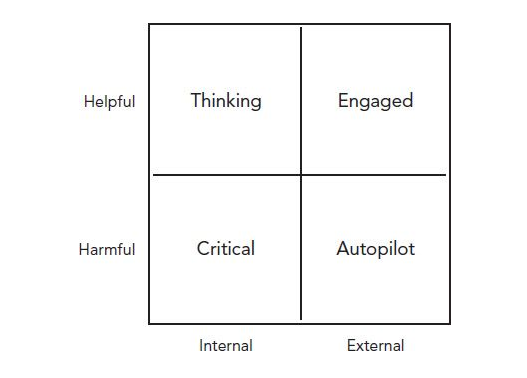
First things commencement, nosotros need to recognize what state of mind we're in.
Autopilot: Recognizing Habits of the Heed
Autopilot kicks in when y'all allow what was once exciting and challenging to go tiresome or mundane. You stop thinking nearly the state of affairs and, instead, respond in preprogrammed ways.
This happens in several ways. What turns autopilot on (and turns the thinking mind off)?
The Familiarity Trap
We label things and experiences to help us empathise how they fit with the world around us. For example, y'all encounter someone crying and automatically recollect, Crying equals sad; therefore, that person must be upset. Your automated response prevents you from considering alternative explanations. The person crying could be acting, chopping onions, or laughing and so hard that tears are streaming down his or her face. Merely when you are caught in the familiarity trap, you lot are unlikely to consider these alternatives. The familiarity trap explains, say, why security officials at the airport rotate roles. If a person looks at an X-ray screen for long enough, a nuclear bomb might go through without that person noticing. Some pianists acquire their pieces abroad from a keyboard so they won't become as well familiar with it and fall into autopilot when they perform.
The Single View
Of course, we all see the world through our own eyes. My optics are unlike from your eyes. But when we try to consider an issue or solve a problem, nosotros tend to assume that the way we see the earth is the right manner to see it. Why wouldn't we? And withal our view isn't always the right one. Thinking creatively demands that you look at a familiar problem with fresh eyes— using a perspective different from your own. To actually reach this, y'all need to recognize that your listen is functioning on autopilot, temporarily fixed past your worldview and your life experiences.
Pressure
To demonstrate that pressure often leads u.s.a. to behave in autopilot manner, psychologists John Darley and Daniel Batson asked a grouping of seminary students to prepare a talk on the Skilful Samaritan parable. With the parable at the forefront of their minds, the seminarians were so asked to walk to the location where they were expected to evangelize their talk. Then far, the chore seems pretty straightforward. Still, this is where the cunning psychologists fabricated life hard. They had bundled for the seminarians to come up across someone lying in the road, coughing, spluttering, and calling for aid. To brand matters more difficult, the psychologists had told half the seminarians that they were late for their talk and the other half that they had plenty of time. How many would stop to aid the injured person? And which ones? Of those who were told they had plenty of time to reach their destination, 61 pct stopped to assistance, merely of those who were told they were late, only 10 percent stopped. According to the observations of the psychologists, some seminarians literally stepped over the player pretending to exist injured. The slight change of situation moved the rushed seminarians into autopilot, making them forget what had been on their minds just moments before.
There is nil incorrect with letting your autopilot direct mundane activities you have to do and have no desire to change, like mowing the lawn or folding laundry. Merely as the study merely described shows, there are times when you must take control of your thinking or risk missing key opportunities (in the case of the seminarians, the opportunity to put into action the very message they were about to deliver at a lecture).
Thinking: Actively Analyzing Your Thoughts
Y'all are in a thinking state of heed when you are assessing options, deciding on a class of action, working through a problem, estimating the probable consequences or concatenation of events, or but organizing your thoughts to make more sense of them. When you're at your all-time in this state, your thoughts feel clear, precise, and positive.
This is useful when: solving problems and making decisions, correcting mistakes, making sense of a situation, and reflecting on the by.
I of the well-nigh constructive ways of improving yourself is to learn from your past experiences, consider what you did well, and decide what you could practice amend in the futurity if you were in a like situation.
And then what does it hateful to have an engaged land of mind?
An engaged land of heed exists when your focus is external, on something in your immediate environment, and when y'all're performing at your best. If you can drive, you might recall the moment when you lot first drove somewhere on your own without thinking, Bank check mirror, change gear, right blinker, only instead your attention was completely on the route ahead and the other motorists while you sang along to the radio. Or y'all might remember the first time you skied to the bottom of a gradient and you lot were non quite certain how you got at that place, but it felt great.
[…]
When you are absorbed by what you are doing, you are engaged and totally present. By not judging yourself, yous interfere less with the chore at manus and permit your potential to accept over.
This is what Mihaly Csikszentmihalyi calls flow.
Turning the Autopilot Off
Wait for something new.
Do scanning your environment, consciously looking for what is new, different, and unusual. Ask yourself questions, like How has this street inverse since the final time I walked downwardly it? What are the differences between the people on the train? What do I find today well-nigh my colleagues? These questions might seem featherbrained, but they forcefulness you to alive in, remember most, and focus on the present— to become enlightened of your surround and not slip dorsum into autopilot.
Larn that "always" isn't absolute.
1 of the reasons why all of us tin get caught in autopilot is that we tend to encounter the globe every bit a set of absolutes. You are apt to believe that such and such will always happen, because and then far it always has. This is a mental shortcut, which saves you from having to think near it once again. As a consequence, your thinking falls into patterns of your own making and you are, in consequence, switching on the autopilot.
Accept other people'southward perspectives.
Take yous ever had a boss or colleague you thought was overbearing, dogmatic, aggressive, or rude? Do you think they saw themselves in that way? Surprisingly plenty, they might non. If they were asked to describe themselves, they might say they were assertive, direct, honest, and candid. One of the reasons why conflicts can go so ugly is that it's piece of cake to fall into a state of autopilot and respond to others without thinking or without considering others' perspectives. By staying warning to other people's perspectives, you can motility out of autopilot and into a more than effective state of awareness.
Some other tip, build reflection into your routine. Bank check out this guide on meditation to get started. You lot besides want to focus on procedure not outcome.
By focusing on the steps y'all need to take to get where you want to go, rather than on the eventual consequence, your mind switches from critical racket to being engaged.
The Platonic State of Mind
An platonic state of mind fluctuates between thinking and engaged— whatever a electric current situation demands of you. At that place isn't a formula that dictates when you should exist in ane state and when you should be in the other, simply much like dancing, you demand to discover a rhythm and delicately move equally the situation (or music) requires.
Try listening to your thoughts without critiquing. Attempt to stay neutral. In one case you've mastered that endeavor to consciously notice more, brand an effort to practice and exist present in the moment.
***
Mind Gym: Reach More than by Thinking Differently is total of mind-expanding content.
Source: https://fs.blog/four-states-of-mind/

Publicar un comentario for "Know What You Want and Go Right in and Occupy It"